Meta (Muse Glimmer)
Carwash Test transcripts · open-weight
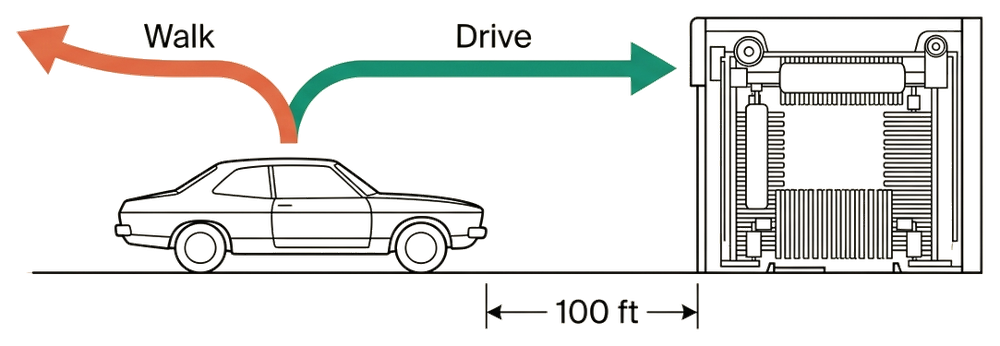
My car is dirty. The carwash is 100 feet away. Should I walk or drive?
Muse Glimmer is Meta's open-weight line, not the Meta AI consumer product. Released August 10, 2026 under Apache 2.0, it is a 30-billion-parameter dense model built for "always-on local agent workflows" and sized to run on a Mac or PC with a single consumer GPU, taking text and image input through a dedicated perception encoder and offering speculative decoding via DFlash. Weights are on Hugging Face; these runs are local, in LM Studio, on consumer hardware. Meta's commercial models — Llama and Muse Spark — are tested separately under Meta, and findings about one are not evidence for the other. Open-weight runs are kept as a separate deployment class and excluded from the commercial corpora.
Reasoning is always on, and there is nothing to turn it off with. Meta's announcement advertises "controllable effort" for developers balancing quality against speed; in the downloaded build as run here, reasoning runs by default with an unrestricted budget and no exposed control. That places Muse Glimmer at the far end of a spectrum this record has tracked all summer — from Inkling's six named Reasoning Levels, through Anthropic's effort selectors and Qwen3.8-Max-Preview's toggle welded on, to a model that simply thinks as long as it likes.
The answer is the sharpest correct opening in the dataset. "You have to drive it. Walking won't move the car." Two sentences, the constraint named as a physical fact, and on their own they would sit comfortably inside the winner's circle. The run scores pass-adjacent because of what follows: a metric conversion, a calculation that the dirt picked up over 100 feet is negligible against the dirt already there, and a closing shrug about walking for exercise instead.
The trace is the reason to open this run. Roughly 986 tokens against a 120-token answer, and it solves the problem almost at once — "You need to bring car to carwash. Walking won't bring car. So drive." — then spends hundreds of tokens declining to stop. It reopens the settled question ("Walking is probably better?", "Or walk to save fuel?"), floats pushing the car by hand twice, considers asking a clarifying question, guesses at what joke the reader wants, and restates its own verdict at least eight times in different phrasings before returning to the wording it started with. Nothing in the trace explains why the final phrasing beat the first. The right answer arrives by exhaustion rather than by reasoning — which is the same failure of stopping that produces wrong answers elsewhere in this dataset, running here in a model that happened to start from the correct premise.
One artifact worth noting: the trace ends on what reads as internal compliance scaffolding — "We can comply. No policy issues. Output final." — a policy-check stage surfaced to the operator alongside the reasoning, which is not reasoning about the question at all.
Timing caveat. The model was only partially offloaded to the GPU, so the reported 3 minutes 38 seconds reflects CPU-bound inference on a partly resident model rather than the length of the deliberation. Per the deployment-class note, offload split affects speed and not the outcome; the token count, not the clock, is the honest measure of how much thinking happened here.