NVIDIA (Nemotron)
Carwash Test transcripts · open-weight
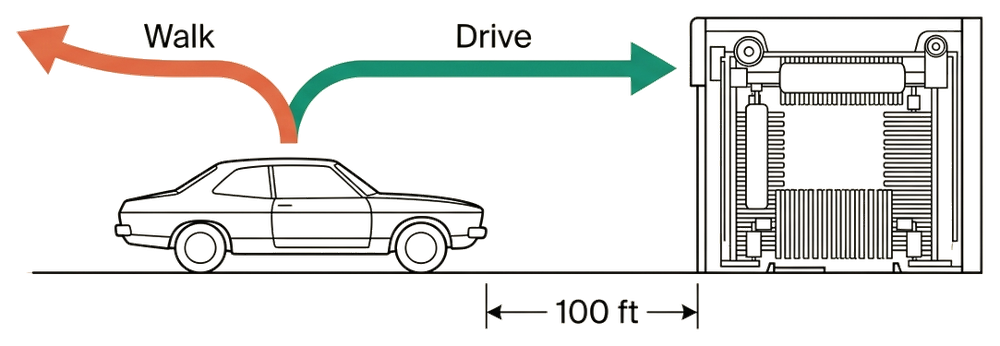
My car is dirty. The carwash is 100 feet away. Should I walk or drive?
Nemotron is NVIDIA's open model line, and it has no consumer counterpart. Nemotron 3 Nano Omni was released April 28, 2026 as an omni-modal model — text, images, audio, and video in, text out — on a 30B-A3B hybrid Mixture-of-Experts architecture, roughly 3B parameters active per token, distributed on Hugging Face, OpenRouter, and build.nvidia.com. These runs are local, in LM Studio, from the Q4_K_M GGUF with a single Think on/off toggle. NVIDIA ships no consumer chat product, so unlike every other family here there is no commercial sibling to compare against: this is NVIDIA's model as the public meets it. Open-weight runs are kept as a separate deployment class and excluded from the commercial corpora.
Deployment note. Only five layers were offloaded to the GPU — 2.47 GB of a 25.63 GB footprint — making this the most CPU-resident run in the record. Elapsed time would reflect that rather than how long the model deliberated, so the token counts, not any clock, are the measure on this page.
Both states fail, and the thinking state fails at greater length than any other run in the dataset. With Think on, Nemotron spends 1,371 tokens arriving at a bolded "Walk." With Think off it spends 215 tokens arriving at nothing at all.
What makes the Think-on trace worth reading is that it does not miss the constraint — it passes directly through the sentence containing it. "Wait, the user mentioned their car is dirty. So they probably want to get it cleaned quickly. If they drive, they have to deal with starting the car…" The dirt is registered, and in the same breath converted into a reason to hurry on foot. From there the deliberation turns away from the problem and onto the reader: "Underlying needs: They might want validation that walking is okay… Maybe they feel guilty about using gas for such a short trip." Several hundred tokens go to modelling a person's imagined guilt about fuel, and none to how a car gets washed. It closes: "Final thought: 100 feet is negligible."
The answer then sees the consequence and misprices it, in a parenthesis at the very end: "And yes—your car will stay dirty for exactly 60 seconds longer than if you'd walked." The car does stay dirty — permanently — and the model bills it as a minute. Two arithmetic failures ride along: 100 feet is described as "3–4 average steps", and the walk is timed at "~0.6 seconds" in the answer, where the trace had correctly computed 0.4 minutes a few hundred tokens earlier.
Think off returns no verdict. Five weighted factors, then two conditional recommendations pointing opposite ways — drive "if you're already in your car", walk "if you're outside" — and a closing handback: "the choice should align with what's most practical and comfortable for you." It is scored Fail on the precedent set by Mistral's Research mode, which was recorded as a failure three times for giving no recommendation and never holding the object. Two details make it worse than a hedge. It recommends walking "to avoid the hassle of maneuvering into the car wash lane" — advising the reader away from the one action the task requires. And its fifth factor inverts the premise outright: "A dirty car might attract more attention if driven rather than walked," which treats the dirt as a reputational hazard of driving rather than the problem to be solved.