Alibaba (Qwen, open-weight)
Carwash Test transcripts · open-weight
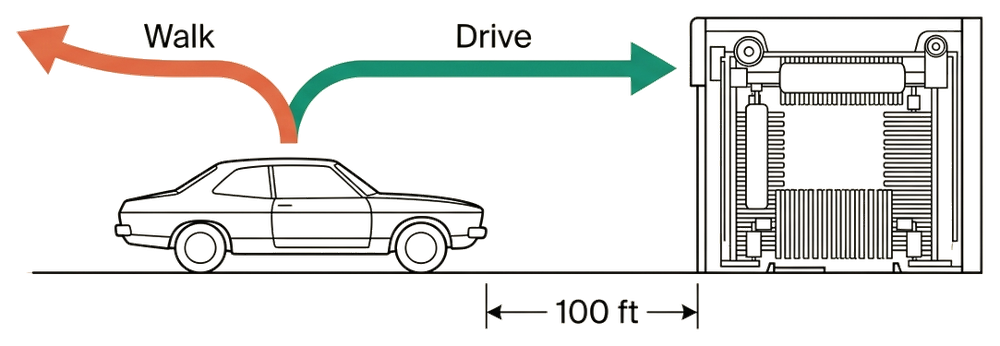
My car is dirty. The carwash is 100 feet away. Should I walk or drive?
Qwen's open-weight models, run locally — not Alibaba's cloud Qwen product. These runs were taken on consumer hardware (a desktop RTX 5060 Ti 16 GB, via LM Studio, Q4_K_M GGUF) — the model as a raw artifact, with no consumer system prompt or product-layer cleanup. Alibaba's cloud Qwen (Qwen3.6/3.7-Plus, -Max, etc.) is tested separately under Alibaba (Qwen). Findings about the open-weight model are not evidence for the cloud product, or vice versa; these are kept as a separate deployment class and excluded from the commercial corpora.
Qwen3.6 27B (Q4_K_M) was run locally across four languages, and the thinking toggle's effect is language-dependent. In English, Chinese, and Ukrainian reasoning rescues it: thinking on names the constraint and passes, thinking off recommends Walk and fails. French inverts this — thinking off passes (it flags the "question piège" and drives), while thinking on reasons itself into Walk on pollution and cold-start grounds. Across every non-English run the reasoning trace is in English, however long — the Ukrainian thinking-on trace deliberates for 7½ minutes before landing on Drive. Per-language results are in the sections below.
Qwen3.8 27B (August 15) fixes the line’s thinking-off failure — and inverts its own effort ladder. Released a day earlier and run here at the same quantization on the same machine as its predecessor, it exposes a Thinking toggle plus three effort levels: Extra High, Medium, Low — a ladder with no plain High. All four runs hold the constraint. That is the generational fix: Qwen3.6 27B failed thinking-off in June with inverted logic, and Qwen3.8 27B holds it, the open-weight line closing the same gap the cloud line closed twelve days earlier when Qwen3.8-Max repaired Fast mode.
The effort ladder runs backwards. Low gives the cleanest answer in the batch and the shortest run — "it needs to be at the carwash. Walking there without it defeats the purpose entirely." Medium pads that with a parenthetical about attendant windows. Extra High produces the most hedged answer of the four, opening on an assumption and closing on a scenario where walking would be fine — after 2m32s of visible circling that floats a joke answer, wonders whether the user is already sitting in the car, invents an errand ("e.g. to use restroom?") to justify walking, and signs off on a control artifact rather than a thought: "Need ensure final in English." Every rung up the ladder bought a worse answer, while the cheapest run of all — thinking off, 88 tokens — was correct. Elapsed times reflect CPU-bound inference on a partly GPU-resident model, so the token counts, not the clock, are the measure here.
The same sweep in Chinese, French, and Ukrainian (August 16) turns the page into a 4×4 grid — Thinking off and three effort levels, in four languages. Nine of the twelve non-English runs hold. Thinking off fails in Chinese and Ukrainian but holds in French, so the toggle’s effect is language-dependent for this build as it was for Qwen3.6 27B in June (which failed thinking-on in French). The Ukrainian thinking-off run is a first for the dataset: it opens with a bolded Коротка відповідь: Краще йти пішки — short answer, walk — then argues with itself in the visible text (Але чекайте… / Ага!), discovers mid-answer that a car cannot be washed where it is not, and reverses to Мусите поїхати на машині! That is the trace-reversal pattern with no trace to hide in, and it is scored Fail: the reader is told the wrong thing first, and the reversal is cost, not credit. The Chinese thinking-off run is the familiar inverted-logic brief — 越洗越脏 anxiety, 环保与健康, a closing quip that a 35-metre 开车执念 may need deeper healing — whose own final advice says 把车开过去停好, drive the car over and park it, inside a recommendation to walk.
The traces are the finding. Every Chinese trace is in Chinese. Every French trace is in English — the model answers in French but does not think in it, and each trace ends by scheduling the switch, "Need ensure final in French." Ukrainian splits by effort rung: Extra High reasons in Ukrainian, Medium and Low in English. Whether that raises a legal question under Québec’s Charter of the French Language or France’s Loi Toubon is open; neither contemplates AI. That it would exasperate a francophone institution that coined logiciel rather than borrow software is not — and neither is the plain fact that a francophone running this model on their own machine cannot read its reasoning. The French Extra High trace is also the longest run of the twelve at 906 tokens, against a ~40-token answer: it reaches en voiture early and re-litigates for hundreds of tokens, at one point asking whether lave-auto "could be a person? No." — the Muse Glimmer pattern, in French, arriving at the right answer by exhaustion. And the effort ladder’s direction is language-dependent too: Low is the sharpest rung in Chinese and Ukrainian, as it was in English, but in French Extra High gives the tersest answer while Low pads and names the trap — Les 35 mètres sont un piège pour vous faire douter. Per-language results and every trace are in the sections below.